
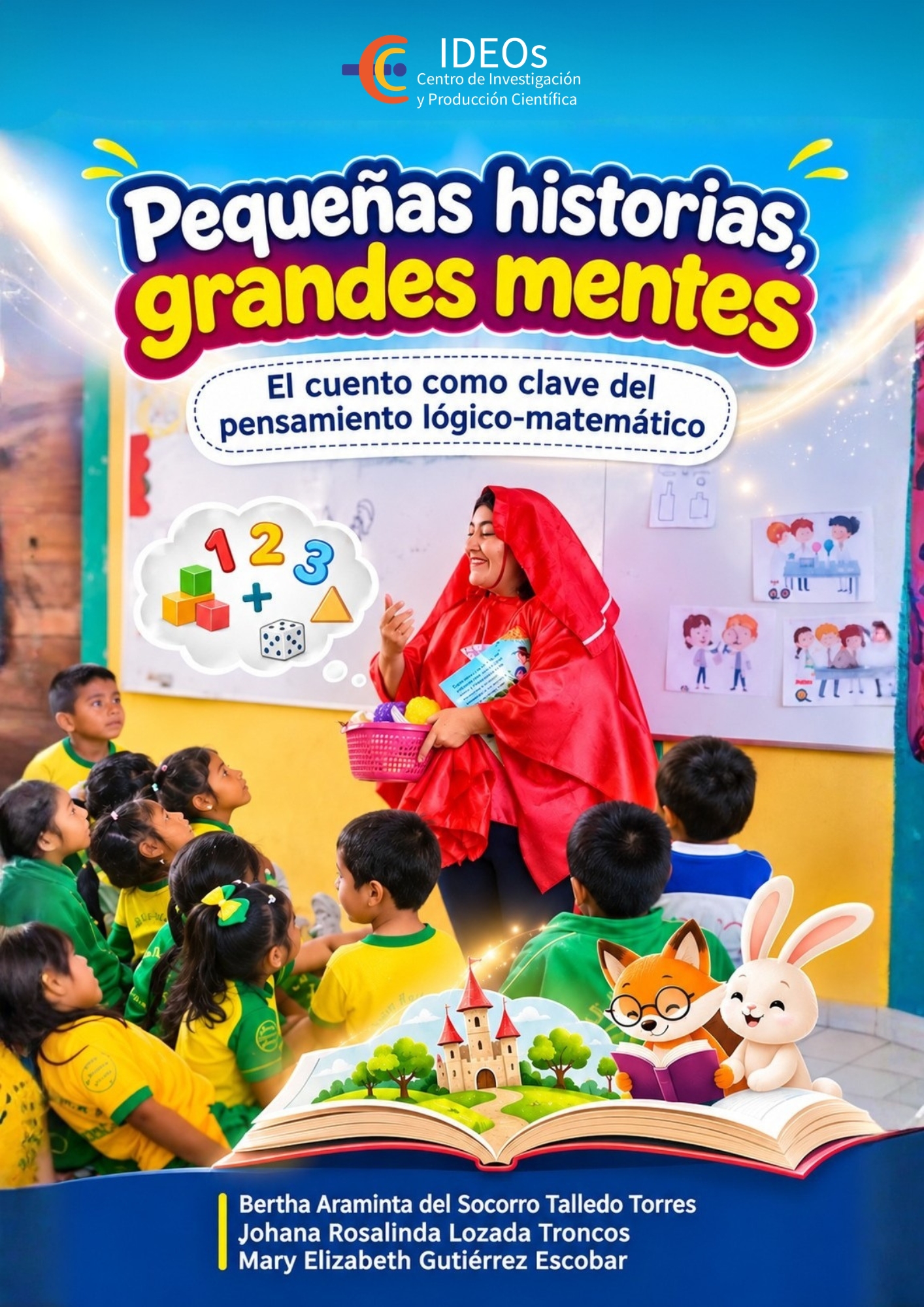
Pequeñas historias, grandes mentes
El cuento como clave del pensamiento lógico-matemático
Abstract
La primera conversación matemática de un niño rara vez se parece a la matemática del cuaderno. Puede comenzar ante tres objetos que no alcanzan para cuatro personas, en la búsqueda de una pieza con la forma adecuada o en la duda sobre qué ocurrió primero. Estas escenas, pequeñas en apariencia, constituyen oportunidades para razonar: ponen en juego relaciones, regularidades y decisiones cuya explicación todavía está naciendo. La educación inicial enfrenta el desafío de cuidar esas preguntas sin transformarlas en ejercicios demasiado precoces.
La narración ofrece un terreno fértil porque en una historia las relaciones importan para alguien. Un personaje espera, compara, ordena, se equivoca y necesita volver a probar. La matemática deja entonces de presentarse como un inventario de etiquetas y se convierte en lenguaje para entender y resolver situaciones. Sin embargo, sería ingenuo concluir que todo cuento enseña matemáticas o que la motivación infantil equivale a un resultado medible. La calidad de una propuesta depende de su construcción intelectual, del diálogo que provoca y de las oportunidades que brinda para verificar una idea.
La investigación sobre libros ilustrados y aprendizaje matemático ha avanzado desde observaciones pedagógicas hacia estudios controlados, revisiones sistemáticas y análisis de la mediación conversacional. Zhang et al. (2023), Skene et al. (2022) y Sun et al. (2026) muestran, desde perspectivas distintas, que los resultados son dependientes de decisiones de diseño e implementación. Esta obra dialoga con esa evidencia sin convertirla en receta universal. Prefiere reconocer condiciones, problemas no resueltos y límites de inferencia.
Un libro científico sobre educación infantil no debería ofrecer solo respuestas. También debe enseñar a diferenciar lo que se observó de lo que se supone, lo que se puede aplicar de lo que aún requiere validación. Esa diferencia resulta especialmente importante cuando los datos de origen presentan resultados que invitan a una lectura cuidadosa. Abordar estas cuestiones con rigor fortalece el valor profesional del estudio y lo sitúa en una conversación científica real.
Los lectores encontrarán una aproximación que une teoría del aprendizaje, análisis narrativo, diseño curricular, evaluación y lectura crítica de un caso de aula. Su aporte potencial está en demostrar cómo una pregunta infantil puede convertirse en un problema didáctico legítimo, y cómo la investigación educativa puede transformar una experiencia situada en conocimiento útil sin desprenderse de su contexto ni de sus límites.
References
Arteaga-Martínez, B., Hernández, A., & Macías-Sánchez, J. (2021). El aprendizaje de contenidos lógico-matemáticos a través del cuento popular en Educación Infantil. Ocnos, 20(3). https://doi.org/10.18239/ocnos_2021.20.3.2619
Bower, C. A., Zimmermann, L., Verdine, B. N., Toub, T. S., Hirsh-Pasek, K., & Golinkoff, R. M. (2025). What does play have to do with it? A concrete and digital spatial intervention with 3-year-olds predicts spatial and math learning. Developmental Psychology, 61(3), 461–481. https://doi.org/10.1037/dev0001904
Carrazza, C., & Levine, S. C. (2025). Less is not always more: Rich and meaningful counting books lead to greater gains in number understanding than sparse counting books. Developmental Psychology, 61(3), 446–460. https://doi.org/10.1037/dev0001826
Chan, J. Y.-C., & Scalise, N. R. (2022). Numeracy skills mediate the relation between executive function and mathematics achievement in early childhood. Cognitive Development, 62, 101154. https://doi.org/10.1016/j.cogdev.2022.101154
Clements, D. H., Lizcano, R., & Sarama, J. (2023). Research and pedagogies for early math. Education Sciences, 13(8), 839. https://doi.org/10.3390/educsci13080839
Deshmukh, R. S., Pentimonti, J. M., Zucker, T. A., & Curry, B. (2022). Teachers’ use of scaffolds within conversations during shared book reading. Language, Speech, and Hearing Services in Schools, 53(1), 150–166. https://doi.org/10.1044/2021_LSHSS-21-00020
Dunphy, L. (2020). A picture book pedagogy for early childhood mathematics education. En A. MacDonald, L. Danaia, & S. Murphy (Eds.), STEM education across the learning continuum (pp. 67–85). Springer. https://doi.org/10.1007/978-981-15-2821-7_5
Elia, I., Van Den Heuvel-Panhuizen, M., & Georgiou, A. (2010). The role of pictures in picture books on children’s cognitive engagement with mathematics. European Early Childhood Education Research Journal, 18(3), 275–297. https://doi.org/10.1080/1350293X.2010.500054
Ergenekon, E., & Işıkoğlu, N. (2026). Examining the impact of dialogic reading interventions with math picture books. Cognitive Development, 78, 101685. https://doi.org/10.1016/j.cogdev.2026.101685
Flevares, L. M., & Schiff, J. R. (2014). Learning mathematics in two dimensions: A review and look ahead at teaching and learning early childhood mathematics with children’s literature. Frontiers in Psychology, 5, 459. https://doi.org/10.3389/fpsyg.2014.00459
Gibson, D. J., Gunderson, E. A., & Levine, S. C. (2020). Causal effects of parent number talk on preschoolers’ number knowledge. Child Development, 91(6), e1162–e1177. https://doi.org/10.1111/cdev.13423
Griffin, M. K., Brown, M., White, K., Richardson, D., Summers, K., Hanson, M., & Wagner, M. C. (2024). Examining the malleability of young children’s flexible attention to numerical and spatial magnitudes. Early Childhood Research Quarterly, 69, 166–176. https://doi.org/10.1016/j.ecresq.2024.08.003
Ho, J. C.-S., Cheung, S. K., McBride, C., Purpura, D. J., & Ng, M. C. Y. (2025). Relation between general vocabulary knowledge and early numeracy competence: The mediating role of mathematical language. Journal of Experimental Child Psychology, 252, 106145. https://doi.org/10.1016/j.jecp.2024.106145
Hornburg, C. B., King, Y. A., Westerberg, L., Schmitt, S. A., & Purpura, D. J. (2024). The roles of mathematical language and emergent literacy skills in the longitudinal prediction of specific early numeracy skills. Journal of Experimental Child Psychology, 244, 105959. https://doi.org/10.1016/j.jecp.2024.105959
James-Brabham, E., von Bastian, C. C., Brough, C., & Blakey, E. (2025). Do home mathematical activities relate to early mathematical skills? A systematic review and meta-analysis. Child Development, 96(1), 451–468. https://doi.org/10.1111/cdev.14162
Larkin, K., Resnick, I., & Lowrie, T. (2024). Preschool children’s repeating patterning skills: Evidence of their capability from a large scale, naturalistic, Australia wide study. Mathematical Thinking and Learning, 26(2), 127–142. https://doi.org/10.1080/10986065.2022.2056320
Libertus, M., Miller, P., Zippert, E. L., Bachman, H. J., & Votruba-Drzal, E. (2024). Predicting individual differences in preschoolers’ numeracy and geometry knowledge: The role of understanding abstract relations between objects and quantities. Journal of Experimental Child Psychology, 247, 106035. https://doi.org/10.1016/j.jecp.2024.106035
Lozada Troncos, J. R., & Pazo Querevalu, P. M. (2026). Uso del cuento para el desarrollo del pensamiento lógico-matemático en niños de 4 años del nivel inicial de la Institución Educativa 14121 La Arena – 2025 [Tesis de licenciatura, Universidad Nacional de Piura]. https://repositorio.unp.edu.pe/bitstreams/42f89381-be09-4bac-b88e-ad2e34c547ab/download
Marín Rodríguez, M. (2007). El valor matemático de un cuento. Sigma, 31, 11–26. https://dialnet.unirioja.es/servlet/articulo?codigo=2532738
Marín Rodríguez, M. (Coord.). (2013). Cuentos para aprender y enseñar matemáticas en Educación Infantil. Narcea.
Ministerio de Educación del Perú. (2016). Programa curricular de Educación Inicial. https://hdl.handle.net/20.500.12799/4548
Organisation for Economic Co-operation and Development. (2026). Building strong foundations for life: Results from the 2025 Early Learning and Child Well-being Study. OECD Publishing. https://doi.org/10.1787/02bf8efe-en
Purpura, D. J., Napoli, A. R., Wehrspann, E. A., & Gold, Z. S. (2017). Causal connections between mathematical language and mathematical knowledge: A dialogic reading intervention. Journal of Research on Educational Effectiveness, 10(1), 116–137. https://doi.org/10.1080/19345747.2016.1204639
Saá Rojo, M. D. (2002). Las matemáticas de los cuentos y las canciones. Editorial EOS.
Skene, K., O’Farrelly, C. M., Byrne, E. M., Kirby, N., Stevens, E. C., & Ramchandani, P. G. (2022). Can guidance during play enhance children’s learning and development in educational contexts? A systematic review and meta-analysis. Child Development, 93(4), 1162–1180. https://doi.org/10.1111/cdev.13730
Strouse, G. A., Nyhout, A., & Ganea, P. A. (2018). The role of book features in young children’s transfer of information from picture books to real-world contexts. Frontiers in Psychology, 9, 50. https://doi.org/10.3389/fpsyg.2018.00050
Sun, J., Xie, S., Li, J.-B., Li, J., & Mu, F. (2026). Early mathematics interventions in pre-primary education: A three-level meta-analysis of intentional teaching and exploratory play approaches. Educational Research Review, 52, 100830. https://doi.org/10.1016/j.edurev.2026.100830
Torres-Peña, R. C., Peña-González, D., & Ariza-Echeverri, E. A. (2025). Mathematical thinking in preschool: Strengthening seriation and counting through problem solving. International Journal of Early Childhood, 57, 379–401. https://doi.org/10.1007/s13158-024-00402-4
UNESCO & UNICEF. (2024). Global report on early childhood care and education: The right to a strong foundation. UNESCO y UNICEF. https://www.unicef.org/reports/global-report-early-childhood-care-and-education-right-strong-foundation
Van Den Heuvel-Panhuizen, M., Elia, I., & Robitzsch, A. (2016). Effects of reading picture books on kindergartners’ mathematics performance. Educational Psychology, 36(2), 323–346. https://doi.org/10.1080/01443410.2014.963029
Wang, M., Vasilyeva, M., & Laski, E. V. (2024). Words matter: Effect of manipulating storybook texts on parent and child math talk. Early Childhood Research Quarterly, 69, 65–77. https://doi.org/10.1016/j.ecresq.2024.07.002
Wijns, N., Verschaffel, L., De Smedt, B., & Torbeyns, J. (2021). Associations between repeating patterning, growing patterning, and numerical ability: A longitudinal panel study in 4- to 6-year-olds. Child Development, 92(4), 1354–1368. https://doi.org/10.1111/cdev.13490
Zhang, Q., Sun, J., & Yeung, W.-Y. (2023). Effects of using picture books in mathematics teaching and learning: A systematic literature review from 2000–2022. Review of Education, 11(1), e3383. https://doi.org/10.1002/rev3.3383
Downloads
Published
How to Cite
Issue
Section
License

This work is licensed under a Creative Commons Attribution 4.0 International License.
This license allows others to redistribute, remix, tweak, and build upon your work, even with commercial penalties, as long as you take credit for the original creation. This is the most helpful license offered. Recommended for maximum dissemination and use of the materials subject to the license.


