
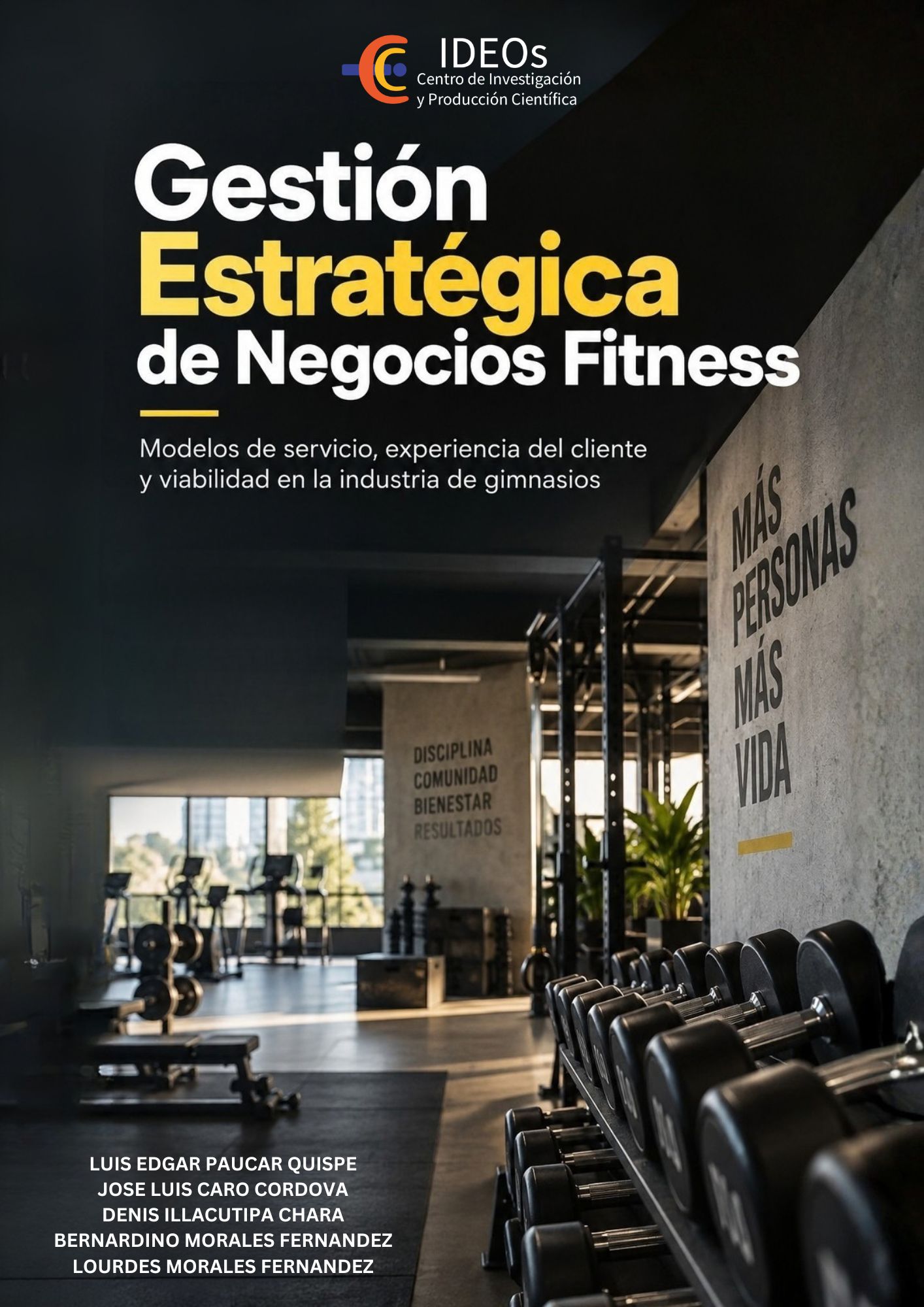
Gestión estratégica de negocios Fitness
Modelos de servicio, experiencia del cliente y viabilidad en la industria de gimnasios
Abstract
El centro fitness contemporáneo ocupa una posición singular entre la empresa de servicios, la promoción de estilos de vida activos y la economía de la experiencia. Su operación combina infraestructura, conocimiento técnico, interacción humana, tecnología y disciplina financiera. Esa mezcla explica por qué un gimnasio no puede gestionarse como un simple espacio con máquinas: la decisión de asistir, permanecer, abandonar o recomendar depende de la forma en que el usuario interpreta el valor recibido y de la capacidad de la organización para acompañar objetivos diversos sin confundir bienestar, entrenamiento y atención sanitaria.
La relevancia científica de estudiar estos servicios crece en un entorno donde la inactividad física mantiene un peso importante en la carga de enfermedad y, simultáneamente, las personas incorporan tecnologías de seguimiento, aplicaciones móviles y nuevas modalidades de entrenamiento. La Organización Mundial de la Salud ha reiterado que la actividad física regular aporta beneficios físicos y mentales y que una proporción considerable de adultos no alcanza las recomendaciones vigentes (World Health Organization, 2024). El reto empresarial consiste en convertir esa necesidad social en servicios responsables, accesibles, medibles y sostenibles.
Esta obra desarrolla una mirada de gestión integral. La evidencia empírica de un plan de negocios realizado en Trujillo funciona como caso de estudio histórico y permite observar con detalle preferencias, precios, atributos, operaciones y proyecciones financieras. Sobre esa base se amplían los marcos de calidad, experiencia, fidelización, tecnología, comportamiento y diseño estratégico, de modo que el lector pueda distinguir entre los hallazgos originales de 2017 y las implicaciones que surgen al contrastarlos con literatura más reciente.
El aporte del libro reside en esa articulación entre investigación aplicada y actualización conceptual. No pretende convertir un caso particular en una regla universal; busca mostrar cómo una investigación de mercado puede dialogar con teorías de comportamiento, calidad de servicio, modelo de negocio y transformación digital, y cómo la viabilidad financiera debe interpretarse junto con la experiencia del usuario, la capacidad operativa y el entorno regulatorio.
References
Ajzen, I. (1991). The theory of planned behavior. Organizational Behavior and Human Decision Processes, 50(2), 179-211. https://doi.org/10.1016/0749-5978(91)90020-T
Barbosa, H. F., García-Fernández, J., Pedragosa, V., & Cepeda-Carrion, G. A. (2021). The use of fitness centre apps and its relation to customer satisfaction: A UTAUT2 perspective. International Journal of Sports Marketing and Sponsorship, 23(5), 966-985. https://doi.org/10.1108/IJSMS-01-2021-0010
Brickwood, K. J., Watson, G., O’Brien, J., & Williams, A. D. (2019). Consumer-based wearable activity trackers increase physical activity participation: Systematic review and meta-analysis. JMIR mHealth and uHealth, 7(4), e11819. https://doi.org/10.2196/11819
Bull, F. C., Al-Ansari, S. S., Biddle, S., Borodulin, K., Buman, M. P., Cardon, G., Carty, C., Chaput, J.-P., Chastin, S., Chou, R., Dempsey, P. C., DiPietro, L., Ekelund, U., Firth, J., Friedenreich, C. M., Garcia, L., Gichu, M., Jago, R., Katzmarzyk, P. T., ... Willumsen, J. F. (2020). World Health Organization 2020 guidelines on physical activity and sedentary behaviour. British Journal of Sports Medicine, 54(24), 1451-1462. https://doi.org/10.1136/bjsports-2020-102955
Caro Córdova, J. L., Herrada Villarreal, D. O., Navarro Hidalgo, E., & Zegarra Loo, J. A. (2017). Plan de negocio para la implementación de un gimnasio en la ciudad de Trujillo en el NSE A y B [Tesis de maestría, Universidad ESAN].
Davergne, T., Meidinger, P., Dechartres, A., & Gossec, L. (2023). The effectiveness of digital apps providing personalized exercise videos: Systematic review with meta-analysis. Journal of Medical Internet Research, 25, e45207. https://doi.org/10.2196/45207
Deci, E. L., & Ryan, R. M. (2000). The “what” and “why” of goal pursuits: Human needs and the self-determination of behavior. Psychological Inquiry, 11(4), 227-268. https://doi.org/10.1207/S15327965PLI1104_01
Ding, D., Lawson, K. D., Kolbe-Alexander, T. L., Finkelstein, E. A., Katzmarzyk, P. T., van Mechelen, W., & Pratt, M. (2016). The economic burden of physical inactivity: A global analysis of major non-communicable diseases. The Lancet, 388(10051), 1311-1324. https://doi.org/10.1016/S0140-6736(16)30383-X
Ferguson, T., Olds, T., Curtis, R., Blake, H., Crozier, A. J., Dankiw, K., Dumuid, D., Kasai, D., O’Connor, E., Virgara, R., & Maher, C. (2022). Effectiveness of wearable activity trackers to increase physical activity and improve health: A systematic review of systematic reviews and meta-analyses. The Lancet Digital Health, 4(8), e615-e626. https://doi.org/10.1016/S2589-7500(22)00111-X
García-Pascual, F., Parra-Camacho, D., & Aguado-Berenguer, S. (2023). Effect of service experience, engagement and satisfaction on the future intentions of customers of a sports services. Heliyon, 9(7), e17850. https://doi.org/10.1016/j.heliyon.2023.e17850
Guthold, R., Stevens, G. A., Riley, L. M., & Bull, F. C. (2018). Worldwide trends in insufficient physical activity from 2001 to 2016: A pooled analysis of 358 population-based surveys with 1.9 million participants. The Lancet Global Health, 6(10), e1077-e1086. https://doi.org/10.1016/S2214-109X(18)30357-7
Gálvez-Ruiz, P., Calabuig, F., Grimaldi-Puyana, M., González-Serrano, M. H., & García-Fernández, J. (2023). The effect of perceived quality and customer engagement on the loyalty of users of Spanish fitness centres. Academia Revista Latinoamericana de Administración, 36(4), 445-462. https://doi.org/10.1108/ARLA-01-2023-0014
Hallal, P. C., Andersen, L. B., Bull, F. C., Guthold, R., Haskell, W., & Ekelund, U. (2012). Global physical activity levels: Surveillance progress, pitfalls, and prospects. The Lancet, 380(9838), 247-257. https://doi.org/10.1016/S0140-6736(12)60646-1
Huang, Y., & Kim, D. (2023). How does service quality improve consumer loyalty in sports fitness centers? The moderating role of sport involvement. Sustainability, 15(17), 12840. https://doi.org/10.3390/su151712840
Instituto Nacional de Estadística e Informática. (2025). Perú: Enfermedades no transmisibles y transmisibles, 2024. INEI.
Jeon, Y., Kim, D., Han, S., Huang, Y., & Kim, J. (2021). How does service environment enhance consumer loyalty in the sport fitness industry? The role of servicescape, consumption motivation, emotional and flow experiences. Sustainability, 13(11), 6414. https://doi.org/10.3390/su13116414
Lee, S. Y. (2017). Service quality of sports centers and customer loyalty. Asia Pacific Journal of Marketing and Logistics, 29(4), 870-879. https://doi.org/10.1108/APJML-10-2016-0191
Lemon, K. N., & Verhoef, P. C. (2016). Understanding customer experience throughout the customer journey. Journal of Marketing, 80(6), 69-96. https://doi.org/10.1509/jm.15.0420
Loranca-Valle, C., Cuesta-Valiño, P., Núnez-Barriopedro, E., & Gutiérrez-Rodríguez, P. (2021). Management of loyalty and its main antecedents in sport organizations: A systematic analysis review. Frontiers in Psychology, 12, 783781. https://doi.org/10.3389/fpsyg.2021.783781
Osterwalder, A., & Pigneur, Y. (2010). Business model generation: A handbook for visionaries, game changers, and challengers. John Wiley & Sons.
Parasuraman, A., Zeithaml, V. A., & Berry, L. L. (1988). SERVQUAL: A multiple-item scale for measuring consumer perceptions of service quality. Journal of Retailing, 64(1), 12-40.
Porter, M. E. (1985). Competitive advantage: Creating and sustaining superior performance. Free Press.
Porter, M. E. (2008). The five competitive forces that shape strategy. Harvard Business Review, 86(1), 78-93.
Ryan, R. M., & Deci, E. L. (2020). Self-determination theory: Basic psychological needs in motivation, development, and wellness. Guilford Press.
Strain, T., Flaxman, S., Guthold, R., Semenova, E., Cowan, M., Riley, L. M., Bull, F. C., Stevens, G. A., & Country Data Author Group. (2024). National, regional, and global trends in insufficient physical activity among adults from 2000 to 2022: A pooled analysis of 507 population-based surveys with 5.7 million participants. The Lancet Global Health, 12(8), e1232-e1243. https://doi.org/10.1016/S2214-109X(24)00150-5
Teixeira, P. J., Carraça, E. V., Markland, D., Silva, M. N., & Ryan, R. M. (2012). Exercise, physical activity, and self-determination theory: A systematic review. International Journal of Behavioral Nutrition and Physical Activity, 9, 78. https://doi.org/10.1186/1479-5868-9-78
Vargo, S. L., & Lusch, R. F. (2004). Evolving to a new dominant logic for marketing. Journal of Marketing, 68(1), 1-17. https://doi.org/10.1509/jmkg.68.1.1.24036
World Health Organization. (2022). Global status report on physical activity 2022. World Health Organization. https://www.who.int/publications/i/item/9789240059153
World Health Organization. (2024). Physical activity. https://www.who.int/news-room/fact-sheets/detail/physical-activity
Downloads
Published
How to Cite
Issue
Section
License

This work is licensed under a Creative Commons Attribution 4.0 International License.
This license allows others to redistribute, remix, tweak, and build upon your work, even with commercial penalties, as long as you take credit for the original creation. This is the most helpful license offered. Recommended for maximum dissemination and use of the materials subject to the license.


